
Q What problems are you trying to solve?
Henze: Asset owners today are focused on investments designed to solve problems specific to their institutions. We’ve developed a spectrum of outcome-oriented solutions using a portfolio construction philosophy that is rooted in the principles of consistency, diversification, and downside protection. Specifically, we draw on three building blocks — traditional betas, alpha, and alternative betas — and combine them in order to pursue a range of risk and return objectives. Each component is built from the bottom up with a specific objective in mind. For example, traditional betas are implemented with a custom indexing process often referred to as “smart beta” — rules-based, long-only investments that seek to deliver a better risk and return profile than conventional market-cap-weighted approaches.
We think these strategies can help investors looking to implement an alternatives allocation but struggling because some of the traditional options, such as hedge funds, are closed; are not delivering on their performance objectives; or present fee, transparency, and liquidity hurdles. We’re seeking to provide access to similar sources of return as some of those investments, but in risk-targeted, dynamically managed, and liquid offerings with more attractive fees.
Q How do you define alternative betas, and how can they help improve portfolio diversification?
Gorman: We regard alternative betas as systematic exposures motivated by an economic rationale and accompanied by a positive expected return — in other words, a compensated risk factor. The positive return reflects some combination of risk premia (e.g., credit spreads) and behavioral drivers (e.g., momentum).
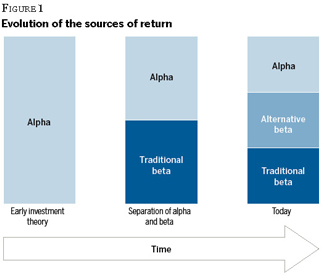
To understand how alternative betas can help diversify a portfolio, it helps to consider how the evaluation of portfolio performance has evolved over time (Figure 1). Early investment theory attributed alpha purely to manager skill. The Capital Asset Pricing Model introduced the notion of systematic risk (beta), and measures like Jensen’s alpha (a measure of beta-adjusted excess return developed by economist Michael Jensen) soon followed. One can think of this as the alpha/beta separation. Researchers like Eugene Fama and Kenneth French moved beyond beta and identified systematic sources of return, such as value and size. Such research effectively expanded the notion of beta while narrowing the concept of alpha and laid the foundation for alternative betas as a third source of returns.
Each of these return sources has a role to play. With tight risk control, beta provides traditional market participation, alpha adds return and diversifies risk through individual security selection, and alternative beta provides the potential for differentiated return streams with low correlation to traditional markets as well as to each other. What we’re seeking to provide is an approach that pulls together these return sources in an integrated, risk-controlled framework.
“ …alternative beta provides the potential for differentiated return streams with low correlation to traditional markets as well as to each other.”
Q What is your approach to investing in alternative betas?
Ritsko: We dynamically manage alternative beta exposures, meaning that we participate when we think the probability of success is high and are comfortable being on the sidelines when returns appear less certain. We don’t want to chase returns, and would rather sit out when we believe a strategy could be challenged. In terms of risk management, we seek protection in the form of diversification and proprietary downside controls that include position-level filters and systematic drawdown mitigation.
We invest in alternative betas because we believe doing so provides a better opportunity for attractive Sharpe ratios and reduced correlation to traditional asset classes. We start with an economic rationale and an expected Sharpe ratio hurdle and use managed or “active” positions, not passive buy-and-hold exposures. We target a broad array of instruments and trade types, considering cash requirements and operational burden, and all of our alternative betas are liquid exposures. We are not pursuing an illiquidity premium because we think it’s critical to provide clients with a liquid, transparent alternative investment.
Q What alternative betas are in your opportunity set?
Gorman: We currently use four groups of alternative betas: carry, momentum, market relative value, and equity style premia. Let me discuss two of these groups, as examples of how we think about alternative betas. Carry strategies involve investing in higher-yielding markets and shorting lower-yielding markets. These can be defined as status quo trades, meaning you generate a premium and collect the carry as long as the markets don’t change. But when markets experience turmoil or periods of stress, carry strategies can exhibit a strong negative tail. We spend our research energy investigating the tails — trying to provide multi-layered diversification and downside controls to mitigate losses and control correlations.
The momentum group includes trades that seek to take advantage of the persistence of an asset’s recent performance in the near term, or what’s often called trend following. Importantly, momentum trades can profit from negative as well as positive trends — whether the market is up or down, we’re just looking for persistence. We’re also looking for diversification across asset classes and markets when it comes to momentum.
Q What do you bring to the table by combining alternative betas with dynamic asset allocation and fundamental alpha?
Gorman: We think this combination, with its focus on multi-faceted diversification, capital growth, and downside mitigation, is a compelling and unique approach to liquid alternative investments. While investment banks and other asset managers provide access to alternative betas, we think our differentiating factor is the ability to do so within a framework designed to adjust these positions to control volatility and mitigate downside risk. Again, we are aiming to provide clients access to the sources of return available to hedge funds in a risk-targeted, dynamically managed, transparent, and liquid offering.
To learn more about this topic, visit www.wellington.com/alt_beta
Contact information:
Ryan Randolph | rprandolph@wellington.com
1-617-951-5894
This material and/or its contents are current at the time of writing and may not be reproduced or distributed in whole or in part, for any purpose, without the express written consent of Wellington Management. This material is not intended to constitute investment advice or an offer to sell, or the solicitation of an offer to purchase shares or other securities. Investors should always obtain and read an up-to-date investment services description or prospectus before deciding whether to appoint an investment manager or to invest in a fund. Any views expressed herein are those of the author(s), are based on available information, and are subject to change without notice. Individual portfolio management teams may hold different views and may make different investment decisions for different clients.